
Scores are generally understood in terms of symbolizations of processes, which extend over time. The most familiar kind of “score” is a musical one in which a musician follows a set of notes on a page, over the course of a performance. In the field of movement-based Expressive Arts, its meaning is extended to include scoring creative human activity. First developed and presented by Lawrence and Anna Halrpin in 1969, their method of scoring is a learning template used for designing the themes, intentions, resources and activities that generate individual and collective problem solving and creativity.
Scoring for self-care can look like many different things to many different people. It is as individual as the number of people in the world. Whether it is the habit of doing nothing, proper idleness or puttering to get us back to home base, opening up one mental channel by dabbling in another to gently lure us into action or any other “zoning out” mechanism, self-care is a vital part of the distinctive stages of creativity. It helps us to relax the mind-muscle, before musing upon good, and sometimes great, ideas which animate our way of being, and that is necessary before insight turns to action.
Acknowledging the need to take care, within the practice of art-making, is important for our individual and cultural wellbeing. Some would say that the modern language of creativity has become steeped in pain, desolation and dysfunction, from our youngest achievers to our recognized masters. In fact, art has become closely associated with addictive behaviours and suggestive of a lifestyle filled with suffering. So, many of us today still cast away art-making as either peripheral and frivolous, having a connotation of “the starving artist” or beg the mistaken concept of necessary talent. Those of us who choose to engage in the arts anyway, work incessantly in solitude, or within the “bubble” of an ensemble group, not only disconnected from other human beings, but also from the sentient powerful force of creativity itself. Even worse, our relationship to the art-making process is sometimes emotionally abusive. “If I want to make something, I have to struggle and push myself. This may well be uncomfortable or painful, but that’s the point. No pain, no gain.”
Wikipedia expands on the extreme end of the spectrum:
“The tortured artist is a stock character and real-life stereotype who is in constant torment due to frustrations with art and other people. Tortured artists feel alienated and misunderstood due to the perceived ignorance or neglect of others who do not understand nor support them and the things they feel are important. They sometimes smoke, experience sexual frustration and recurring heartbreak, and generally appear overwhelmed by their own emotions and inner conflicts. They are often mocked in popular culture for “thinking too much”, being quixotic, or coming across as pretentiously averse to happiness and fun. Other stereotypical traits vary between extremes—from being narcissistic and extraverted to being self-loathing and introverted. Tortured artists are often self-destructive in behaviour and are generally associated with mental health issues such as substance abuse, personality disorders or depression. Tortured artists are often prone to self-mutilation and have a high rate of suicide.”
Wikipedia
Elizabeth Gilbert offers a different viewpoint:
“Addiction does not make the artist… I believe that creativity grows like sidewalk weeds, out of the cracks between pathologies, not from the pathologies themselves.”
“Big Magic”, Elizabeth Gilbert
Artists are actually poised to live a life filled with innovation, exploring new ways of doing things, and bringing dreams to a reality that is useful to us and others. The first step though is self-care.
Scoring for self-care is not about selfishness or egotism, but, rather, the opposite. It takes us out of ourselves, our self-doubt, self-judgement, and allows us to engage more fully with life. These are our lives. Ours to spread joy. Let us feel great! We have to teach ourselves that we have a right to even be here through our loving action toward ourselves, the arrogance of belonging. We have to integrate into our practice the concept that we might actually be loved in return by the very muse of inspiration that we ourselves revere. Otherwise, our work, our actions, our art, will never be of benefit.
Productivity and output is not the only measure of time well spent. It can also be measured by our ability to pause, check-in and hold tenderly that which we cherish in ourselves. In this way, our self-care becomes a force that can actually take us out of ourselves, allowing us to engage more fully with the world we look to re-create.
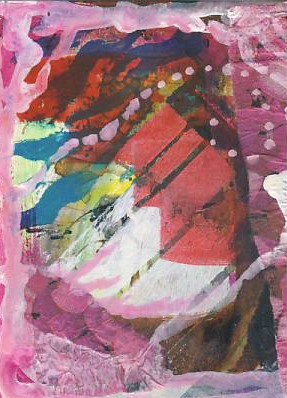
Artwork by Maggie Forgeron,
“Abstract 3”
 Not Just Any Body Part