
Our bodies are speaking to us at all times, if we are paying attention. In this work of Expressive Arts, we think of the body as a laboratory, and we are experimenting. We are listening to body wisdom. The body is a biofeedback system, and it communicates to us through our sensory receptors. This is why young children have a tendency to strip down and avoid being confined by clothes. Their bodies need full exposure to the world around them, in order for neural developmental growth. The sensorimotor pathways that connect the world to our bodies, communicating between the brain, spinal cord and skeletal muscles include: vision, taste, hearing, touch, pressure, itch, thermoregulation, smell, proprioception tension sensors, nociception (pain arising from stimulation), equilibrioception (eyes, inner ears & the sense of where the body is in space combined), chemoception (chemical stimulation) and stretch reflex. Basically, the body’s extremities receive and then send sensory input to the brain; the brain integrates that information and sends motor messages back to the body’s extremities. This is called sensory feedback, when the body modifies or controls a process or system of the body, based on information gathered from external stimuli. It is a back and forth process in which the brain requires the active participation of the whole body.
As we age, there are all kinds of barriers that prevent our bodies from giving us clear messages, but the body is constantly processing feedback, regardless. If we move in a certain way, we feel a certain way. We cannot slump forward and feel exalted simultaneously. Likewise, how we feel is reflected in our daily posture. When we are exhausted, the body slumps into a stance of fatigue, in order to hang off the tendons of the body and use as little energy as possible.
When we listen to our bodies, we can intentionally reorganize them in a very deep way. Tuning in will really expose what a person habitually does. First, we observe and notice what we feel. We see if we can feel the areas that are more blank or only the feedback signaling pain. What happens with the brain is that we get dragged toward what hurts, or dragged toward what feels pleasurable. So what we get are these loops where we fixate on a certain feeling, for example a painful knee. The suggestion is not to block out the sensation at the knee but to see if we can observe any sensations above or below the area of pain. It can be helpful to expand the nuance that our brain is able to pick up from what is going on. We do not change movement first, we change how our brain orients to what we are feeling and doing. Lasting change is an inside job.
“Until the body feels something differently, it cannot act differently. Hence, it is that simple, pleasurable, soothing and sustained touch that can so profoundly affect motor patterns that have been established over a lifetime. Muscular conditions can change only when feeling states change.”
“Job’s Body”, Deane Juhan
Expressive Arts adds yet another dimension to the biochemical pathway of response in the bodies’ feedback system, the imagination. We can communicate back and forth with the images and poetic stimuli in our own minds. We can have one image, and it affects us in a certain way, such as systemic racism, climate crisis, global pandemics and pandemonium. We can also affect our bodies by putting ourselves in new situations that encourage selfless courage, acts of goodness and inspiring creativity. By visiting new thought formations and situations, we can foster fresh images and, eventually, creative solutions. So, our whole nervous system, our way of being in the world, can be affected and influenced by this feedback system. We have an incredible opportunity, and, dare I say, responsibility, to tap into the resources within ourselves, by using creativity to re vision and re story our world and ourselves.
Of all the art forms, there is something so unique about dance. When we dance, we consciously choose to use the body as the instrument for art-making. We realize and express through our physicality, and our entire existence lives and breathes within us. We cannot do this kind of investigation anywhere, except within these bodily containers that are communicating with us around the clock, if we are paying attention. That is what time in the art studio can do. It can afford us the opportunity and space to experience who we are, and as we become more and more aware of our own human capacity to meet life through our artistic encounter with our biochemical feedback process, we can deepen our capacity to feedforward. We can use imagination to modify, in anticipation, and prepare for what is to come. There is no way in which to understand the world, except through the radar-net of our senses, and, therefore, we would do well to remember that there is a potent connection to be made through the imagination of a moving body.
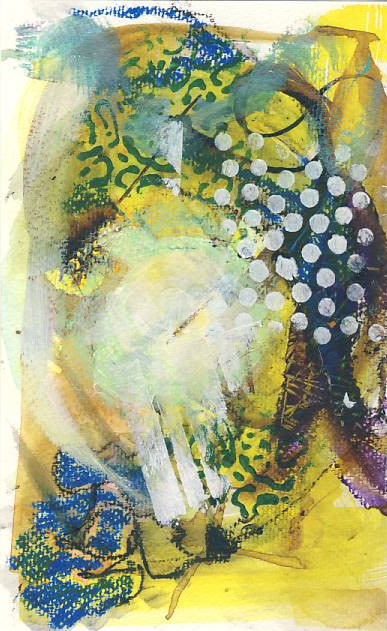
Artwork by Maggie Forgeron,
“Abstract 6”
 Not Just Any Body Part