
What does creative entitlement mean to me? I would say that it is my human right to puncture the air with the vibration of my voice, my idea. I would say that it is my right to open spaces for people to bear their hearts, and I would say that I have the power to make the ordinary into something newly evolved, a kind of Poesis that sets the stage for accessible everyday beauty. There are structures you can follow in experiencing Poesis; bringing something new into being that did not exist before. For myself, it is intrinsically linked to an interplay between art and life.
I came across some video footage of Anna Halprin teaching a workshop in Paris, France. I felt deeply moved when she addressed the participants by speaking the following message:
“The focus of this workshop is on you, and not on me. I’m a facilitator. I can’t do the work for you. I can facilitate and guide you into experiences, but it’s up to you to integrate those experiences.”
Anna Halprin
Expressive Arts is an approach that concentrates on the study of intentional awareness and the objects of direct experience. It corresponds to this idea that truth must be born from personal experience. Our truth comes from our own interaction with the world and our experience of existence. That becomes our truth. It cannot be separated from us.
In that case, my mind cannot help but think about how my existence is in direct relationship to my own mortality. The reason being that, if my experience of truth lives with me, it also dies with me. So, it has this tension. It has this constant relationship to death and my own finite life. In that way, it is easy to fall into this feeling of being alone in a senseless world. It can feel like some sort of heroic act of will to overcome these feelings of nothingness. So, what’s the point of all of it? Where’s the Poesis– the poetic beauty- that could possibly come from such a seemingly stark philosophy?
Though we may experience momentary meaninglessness at the forefront of our minds, we have choices. For one, we can relinquish control over the world and just be in it; just be with ourselves and have some sort of faith or trust that the answers are out there and that there is, in fact, meaning. We can be a witness to what is happening in the world, and when we let go of our grasping, interesting things can happen. Accessible everyday magic can happen.
So then the question becomes, how do we just be with it? How do we hold it all? As the folk trio “Red Molly” sings, “It seems there’s no escape. We are part beauty and part heartbreak.” Expressive Arts is a tool to shape and reshape those myriad of life experiences through arts-based play. Art has its own way of manifesting itself and bringing meaning. It becomes a kind of healthy companion.
When I can craft my life themes into a story to share with others, someone might respond with some poetry, which makes me feel more connected and embodied with my experience. If I can sing in an ensemble, it can become a ritual of cooperation and teamwork. If I can build a theatre play that depicts real life situations, it may heighten empathy and sensitivity in my viewers, as they experience an enhanced sense of understanding as people, as cultures. In these ways, we become less likely to suffer alone and have no other outlet than to talk and stew in our own seemingly unchanging issues. Today, more than ever, we need ways to share with each other that are life-affirming and life-giving.
So, Expressive Arts is a way to take care of our health, but it is more than just tending to our own survival needs. Personal health and embodiment is also dependent on sharing the story of our lives- our truth- and giving each other support and validation.
I offer as an example the final curtain call at our “Farewell” show for Kevin O’Day Nationaltheater Mannheim in Germany. The resident company was being replaced, after 14 years of creativity for an always receptive audience. I stood with my entire dance ensemble, my brave- hearted Directors included, waiting for our final bow. Our troupe felt victorious after our four-hour dancing marathon, while simultaneously defeated by the inevitable end to our sweat, blood and sacrifice. The beauty of the moment was tragically going to suffer the death of every other gesture, shape and emotional outpouring on that stage. What happened next, I could have never guessed. The curtain rose to reveal a sea of patrons holding paper banners of blazing red hearts. The arms of that theatre came reaching out, embracing us to be all that we were.
Our hearts may have felt that we stood alone on that stage, tragically sentenced to suffer the immediate end to what we were striving to create. Then we were stunned awake by our own naivety that we were ever really alone at all. What I took away from that experience was a feeling of close and creative involvement in a process and a heightened sense of motivation and direction in my life from its spontaneous outcome. It continues, to this day, to keep me looking for the long-term permutations of a single art-making event. The immateriality of the dance did not diminish it’s truth. It was an unveiling of the world as experienced by me, the subject. Despite the fact that that was my last curtain call on a professional dance stage to date, my interpretation that lives on inside me, is what I carry forever. To me, that is Expressive Arts at its finest.
However, just as Anna Halprin eloquently spoke during her workshop in Paris, the focus of this work is not on me, it is on you. I seek to facilitate experiences that are not dependent on skill, thus opening them to art-makers and self-professed non art-makers. I draw on a model called the Tamalpa Life/Art Process®, as well as from my expanded studies in the field at the European Graduate School. It is an arts-based approach that integrates movement/dance, visual arts, poetic dialogue, performance and therapeutic practices. This approach supports personal, interpersonal and social transformation, while teaching new models for health, psychology, art and communication.
I follow a basic principle in personal and professional development, which is we learn best when we feel safe enough to challenge ourselves with self-motivated risks. My feeling is that change happens when we affirm what is true for each one of us, which allows what wants to come next to naturally emerge.
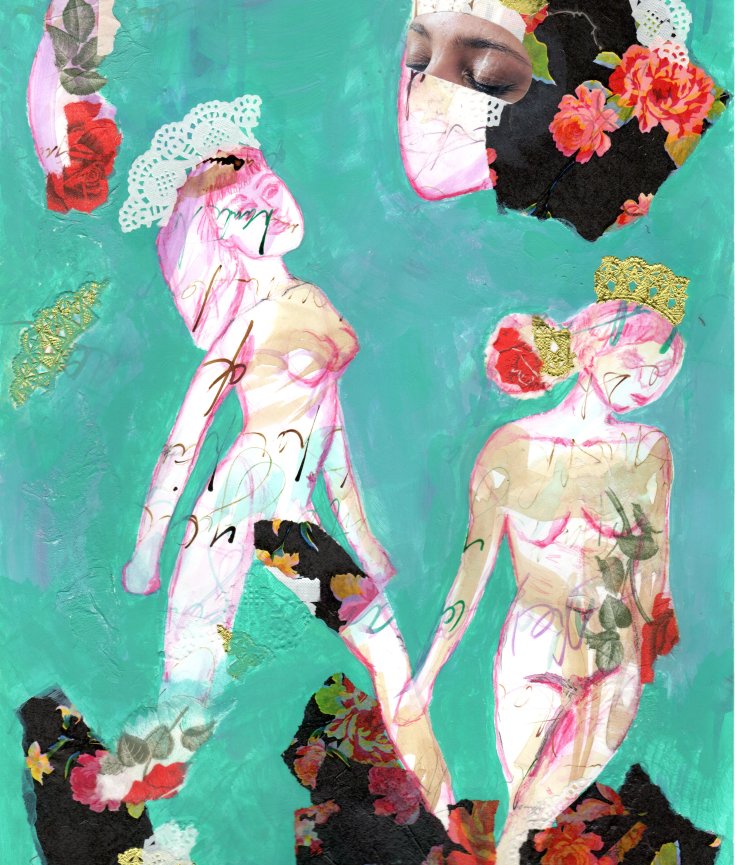
Artwork by Maggie Forgeron,
“Stepping into Womanhood with my Sisters”
 Not Just Any Body Part